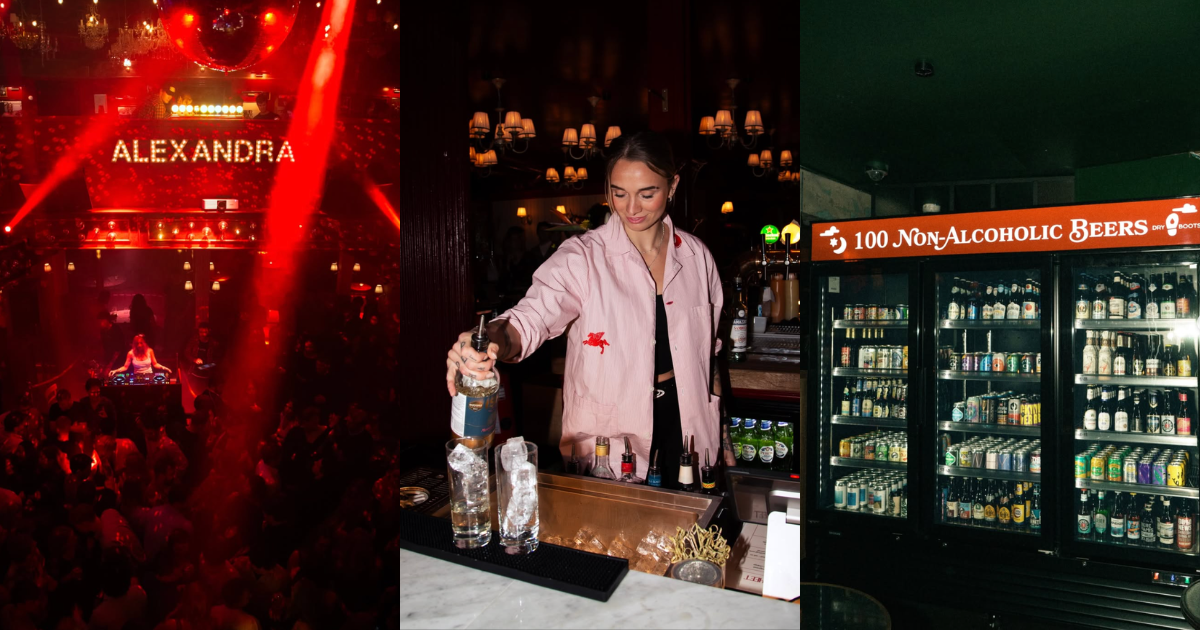
Last month, Copenhagen saw the launch of Alexandra Hus, a mega-bar built on the premise that socializing is an alcohol-optional activity. EVE World, the hospitality collective behind the bar, designed its “triple-format” beverage program, where every drink on the menu is available in three versions: no alcohol, low alcohol, and classic.
This approach isn’t novel—the Danish cocktail bar Bird takes a similar one, and EVE’s other venues had already established the collective’s so-called “NoLo model.” Alexandra Hus is notable, though, for its scale: it supports over 1,000 guests at a time, and its collection of 100 non-alcoholic beers is, per the group, an unofficial Danish record.
From non-alc as a category to ABV as a variable
The conventional on-premise model organizes around alcohol. Non-alc options exist within that framework as alternatives, often implicitly positioned as the lesser choice. This menu architecture communicates compromise before a guest even orders anything.
EVE World operates from a different premise. Co-founder Malthe Geppel describes the menu as built around mood and energy level. ABV is one variable within that, not the organizing principle. “The non-alcoholic choice should not be a subpar alternative,” Geppel says. “We are creating a setting where guests can freely choose between a classic bar menu and a record-breaking selection of non-alcoholic beers and cocktails, without compromising on the party or the aesthetic experience.”
Staff training at EVE begins with this key framing: non-alc is part of the main program, not a substitute. That means equal attention to ingredients, storytelling, and presentation. Pricing reflects the same logic, as EVE prices all three categories at parity.
How guests react to the model
Optionality means more diversity in guest personas. The consumer profile has broadened beyond the wellness-oriented guest that early non-alc programming typically attracted. Geppel’s take: it’s become less about identity and more about occasion.
Geppel describes guests moving across ABV levels within a single visit, perhaps starting with a full-strength cocktail, shifting to a low-ABV option, and finishing with a non-alc serve. It’s primarily about pacing the night. “You should be able to have a massive night out without sacrificing the next day’s energy,” says co-founder Christopher Lyngbye.
It’s a smart business move, as duration and order frequency matter most. Geppel notes that guests with access to excellent options across ABV tiers tend to stay longer and buy more drinks.
The replication question
Alexandra Hus operates at a scale—1,000+ guests, flagship design investment, a group with proven existing venues—that isn’t a direct template for most hospitality operators. The premise, however, is separable from the scale.
Treating non-alc as an integrated option changes what guests encounter and how staff sell. The triple-format menu removes the implicit hierarchy before a guest has to ask: every drink is available in three versions, so no tier is positioned as the fallback. For brands, that means non-alc SKUs seeking on-premise placement increasingly need to hold their own as the feature. Craft-forward positioning matters more than leading on the absence of ABV.
For operators, the question isn’t whether to replicate the format. It’s whether the binary model of drinking or not drinking still reflects how guests are making decisions. EVE World is betting, at 1,000-person scale, that it doesn’t.