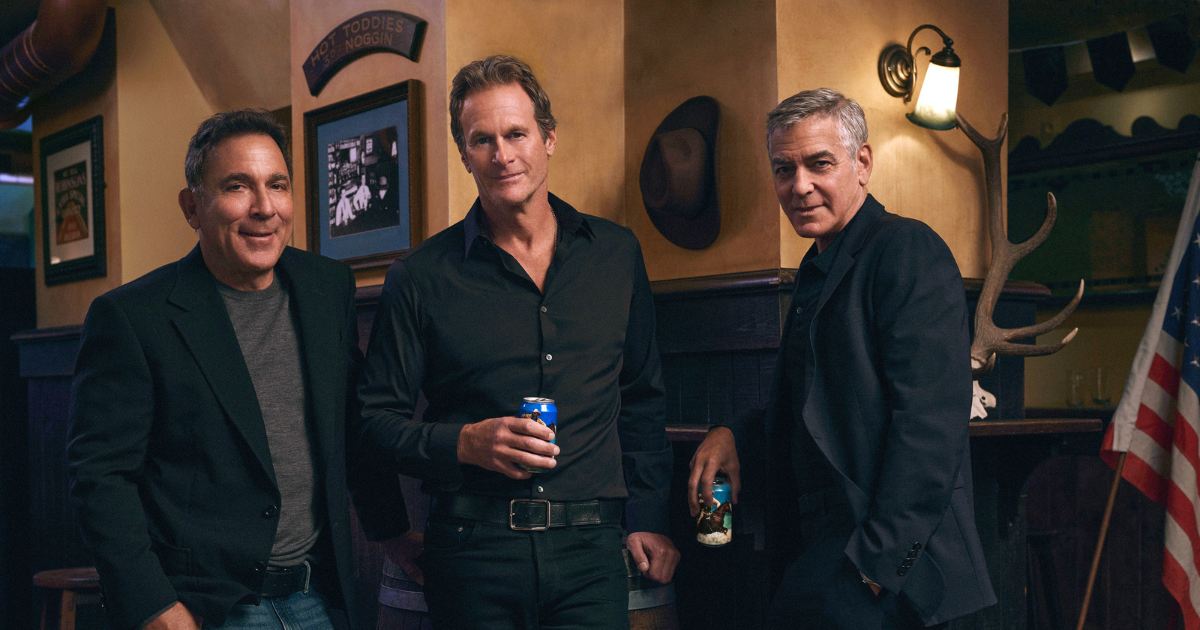
Rande Gerber’s entry into non-alcoholic beer wasn’t an obvious move. His beverage track record runs through Casamigos—the tequila brand he co-founded with George Clooney and sold to Diageo for roughly $1 billion—which makes beer, non-alcoholic or otherwise, an unconventional next step. Crazy Mountain, a premium non-alc lager, launched recently with Clooney again as his co-founder.
But the timing is deliberate. Non-alc beer grew 9% globally last year and is projected to displace ale as the second-largest beer category by volume, and a flurry of celebrity-backed brands have entered the space, like Charlie Sheen’s Wild AF. The harder question is whether celebrity influence can sustain repeat purchase once the novelty cycle ends, a challenge that has tripped up many consumer brands. Our conversation with Gerber suggests he’s thinking about that problem, not just the launch moment.
Dry Atlas: What role do you see celebrity playing at this stage of the non-alcoholic beer category? And where does it stop being an advantage?
Rande Gerber: Celebrity can get attention and spark curiosity—that’s always been true. But it doesn’t build a brand. Authenticity and a great product do. With Crazy Mountain, like with anything I’ve done, it has to be something we actually love, live, and believe in. Celebrity stops being an advantage the moment the product doesn’t speak for itself—and ours does. We’ve created something for people who want to live healthier without giving up the taste, ritual, and satisfaction of a cold one. It’s a premium non-alc lager made using a process where we don’t have to remove alcohol after brewing. If the product isn’t real, if it doesn’t taste great or fit into people’s lives, celebrity doesn’t matter.
DA: How are you thinking about distribution from day one, and which channel matters most for proving product-market fit?
RG: We’ve focused on picking the best beer distributors in each state we open. We’re starting intentionally, with 25 states—including California, Texas, Florida, Illinois, Massachusetts, and Colorado—with national availability planned over the next year. Outside of retail, it’s available online.
Rande Gerber: Brands are ultimately built on-premise. We’ve partnered with some of the best bars and restaurants in the country, from Craig’s in West Hollywood to Morgan Wallen’s This Bar & Tennessee Kitchen in Nashville, and Kid Rock’s bar, also in Nashville.
DA: Many non-alc brands see strong trial but weak repeat. What have you done differently in formulation or positioning to drive reorder, not just first purchase?
RG: It starts with the liquid. We didn’t want to make something that felt like a substitute. We made something that truly tastes like beer, because it is beer. Our process keeps the integrity of the flavor from the start, no shortcuts. Beyond that, it’s about positioning. This isn’t “instead of” something. It’s part of your lifestyle. When it fits naturally into your routine, that’s what drives repeat.
DA: Crazy Mountain’s positioning leans on “adventure” and “freedom.” How do you ensure that translates into a clear use occasion rather than broad lifestyle branding?
RG: For us, “adventure” is real, not just a tagline. And it means something different to everyone: a day of surfing, fishing off the pier, hanging by the fire. These are specific, everyday moments. The idea is that Crazy Mountain fits anywhere you’d normally have a beer. That’s how it becomes real: by showing up consistently in those occasions, not just talking about a lifestyle.
DA: Where do you expect velocity to come from in the first 12–18 months: specific occasions, specific retailers, or specific geographies?
RG: It starts with the right markets, places where people are already leaning into balance and mindful drinking. But real velocity comes from occasions. If we become part of someone’s routine—after a workout, hanging with friends, at a game—that’s what builds momentum. It’s about being present in those memorable moments more than anything else.
DA: How are you thinking about the risk of non-alc beer being reframed as a “wellness product,” and what does that do to long-term scale?
RG: It’s obviously a healthier option, but we don’t consider ourselves a wellness brand. I’m not preaching sobriety—though I’m all for it. This is beer without alcohol. If you’re at a game and have a beer or two, maybe switch to Crazy Mountain for the second half. You’re still in it. It’s about enjoyment, connection, and good times, just with more balance. For us, it’s about choice. That’s what keeps it scalable.
DA: What have you deliberately chosen not to do at launch—SKUs, channels, partnerships—and why?
RG: We’ve kept it focused with just a Classic Lager and a Lime to start. No need to overcomplicate it. Same with distribution and partnerships. We’re not trying to do everything at once. The goal is to build something real and lasting, and that means growing organically and staying true to what we believe in. I do have a few more ideas in the works—natural extensions of the brand—coming soon.
DA: Given your experience with Casamigos, what lessons transfer to non-alc? Which clearly do not?
RG: What transfers is the foundation: authenticity, simplicity, building something you actually want to drink with your friends. That’s how Casamigos started, and it’s the same DNA here. What doesn’t transfer is the category itself. Non-alc is a different mindset. It’s less about indulgence and more about balance. You have to understand how people are living today and build for that.
DA: What would need to be true for this brand to still be on shelf in three years? What are the failure modes you’re watching most closely?
RG: It comes down to the best product we can make and the authenticity of a lifestyle. Nothing else matters. Quality and flavor will keep people coming back. We won’t be changing breweries or our recipe. Consistency is what builds loyalty.
RG: The biggest failure mode is losing that standard. If the product ever feels like a compromise—if it doesn’t deliver the same crisp, clean experience people expect—you’re done.
This interview has been edited for length and clarity. Photo credit: Nathaniel Goldberg.