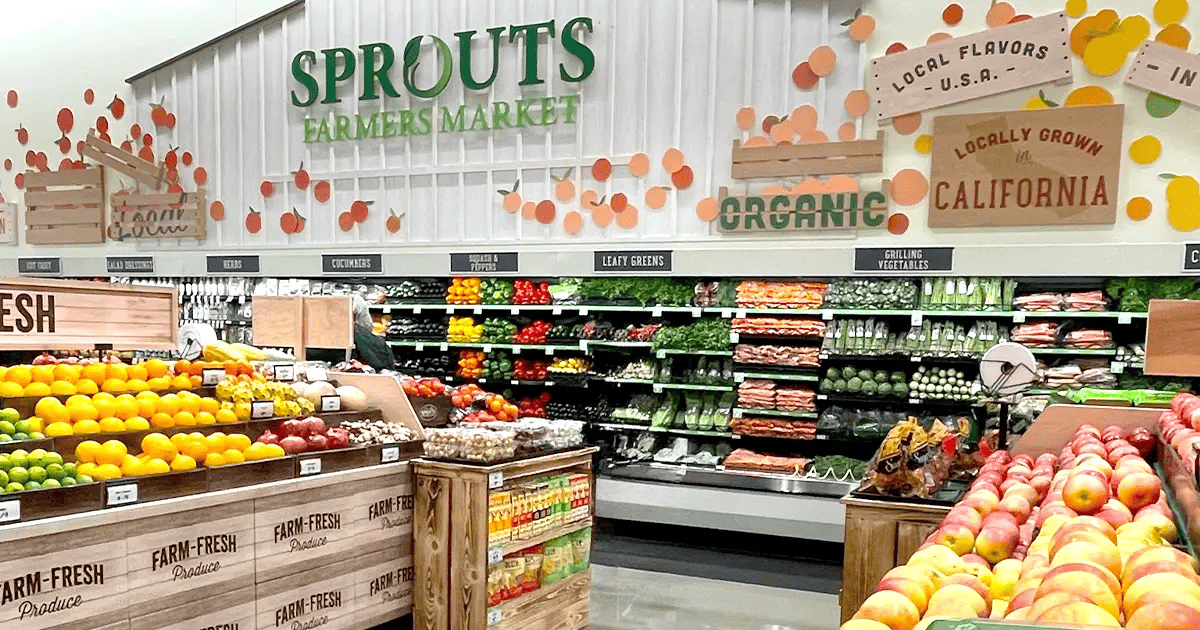
In a category where shelf space is fiercely contested, and emerging brands struggle for visibility, Sprouts Farmers Market has positioned itself as the anti-establishment retailer: one that actively hunts for what’s next rather than waiting for proof points from competitors.
For non-alcoholic beverage founders, that philosophy has created an invaluable launchpad. While other mass retailers demand volume commitments and proven velocity, Sprouts bets on brands it believes can reshape the future of grocery. Lately, they’ve been winning those bets at scale.
Their “Foraging” Philosophy
Sprouts operates with a mandate that sets it apart: differentiation over duplication.
The Phoenix-based grocer focuses exclusively on a $290 billion segment of the food-at-home market, health-conscious consumers willing to seek out attribute-driven products like organic, gluten-free, vegan, and non-GMO options. More than 70% of products sold at Sprouts carry these claims.
To stay ahead of trends, Sprouts deploys “foragers,” a dedicated team that scours conferences, trade shows, and industry events worldwide, searching for innovations that can’t be easily found elsewhere.
When they discover something promising, it enters the Innovation Program: a structured 90-day trial where emerging brands get prime placement in Sprouts’ 455+ stores across 24 states.
“We’re a very good starting point,” CEO Jack Sinclair told Beverage Daily. “Other major retailers are likely to require huge commitments in volumes and money for an initial launch, whereas Sprouts is more oriented to the capabilities of smaller brands.”
The model works. Sprouts introduced more than 7,100 new items in 2024 alone, constantly rotating its assortment to keep the shopping experience fresh. Baskets containing new items come in at more than twice the size of Sprouts’ average basket, proof that innovation drives both discovery and spend.
For non-alc specifically, this couldn’t be more accurate. Sinclair didn’t mince words when speaking to Supermarket Perimeter: “non-alcoholic is on fire.”
So on fire, it seems, that they were very recently on the hunt for new brands. In August of 2025, the retailer partnered with CPG advisor Luke Abbott to host an exclusive Pitch Slam focused on non-alcoholic beers, wines, and RTD cocktails. Brands that applied had the chance to pitch directly to Sprouts’ category management team for placement in Q1 2026, either in the innovation set or the mainline assortment.
The Brands Winning at Sprouts
Several non-alc brands have used Sprouts’ Innovation Program as a springboard to broader retail success, demonstrating what works in this unique channel.
Little Saints, the mushroom-powered brand, exemplifies the model. After founder Megan Klein’s Shark Tank appearance in 2024, the brand hit $1 million in revenue in a single month. But the real validation came when Little Saints entered Sprouts’ Innovation Center and proved it could sell.
De Soi, the adaptogen-infused apéritif co-founded by Katy Perry, launched in Sprouts as part of the 90-day program in January 2024. By year’s end, De Soi had expanded to 8,000+ retail doors and posted 3.3X year-over-year wholesale revenue growth, fueled in part by its early Sprouts validation.
Leilo, the kava-infused brand, also entered through the Innovation Program, marking the largest retail opportunity in the brand’s history. The partnership introduced Leilo’s RTD kava drinks to 400+ stores across 23 states, a distribution footprint that would have been nearly impossible to achieve independently at that stage.
Regional Testing as a Strategic Advantage
Another interesting aspect of Sprouts’ approach is its willingness to test brands regionally before committing to a national rollout. Unlike all-or-nothing retail partnerships, Sprouts uses geographic proximity to its distribution centers (80% of stores are within 250 miles of a DC) to pilot products in specific markets, gather data, and expand based on performance.
Rhinestone, an Arizona-based non-alcoholic beer brand, is a very recent example of this strategy. In January 2026, Rhinestone will launch exclusively in Arizona Sprouts locations, leveraging shared local roots and on-the-ground activations.
This model reduces risk for both retailer and brand. Sprouts doesn’t overcommit inventory or shelf space nationwide, and brands can learn, iterate, and build momentum in a contained geography before scaling.
How Brands Can Approach Sprouts
For founders eyeing Sprouts, the submission process is surprisingly accessible, but the bar for acceptance remains high.
Brands can submit products year-round for most categories, though some follow a structured Submission Calendar with specific windows. Sprouts requires detailed product specs (UPC, case pack, pallet configuration, certifications), cost information (wholesale, FOB, MSRP), and two retail-ready samples per SKU.
Sprouts evaluates products through the lens of its core customer: attribute-driven, health-conscious, and hungry for discovery. Clean ingredient panels, certifications (organic, non-GMO, gluten-free), and a clear point of differentiation are table stakes.
Equally important: alignment with Sprouts’ ethos. The retailer takes pride in curating a portfolio that can’t be found elsewhere, often requesting periods of exclusivity to maintain differentiation. Brands willing to grant that exclusivity (and commit to supporting their launch with sampling, education, and marketing) tend to fare better.
The Broader Opportunity
For 2025, Sprouts projects net sales growth between 10.5% and 12.5%, with comparable-store sales rising 4.5% to 6.5%. Beyond the numbers, though, is a much rarer benefit: a genuine willingness to take calculated risks on unproven brands.
For non-alc founders, Sprouts represents many vital things: a credibility builder, a proof point for investors, and a testing ground that can inform national expansion strategies. The grocer’s innovation-first model has already aided in the launch of some of the category’s most successful brands. The question now is which brands will be next.