Presented by Rho
For most early-stage non-alc brands, marketing decisions are shaped by one overriding constraint: what can be cleanly attributed in a dashboard.
If you can’t track it, it feels hard to justify. Tactics like paid social and retargeting promise fast feedback and clean numbers. In a capital-intensive category, that clarity feels responsible. It’s also incomplete.
Some of the most effective marketing levers in non-alc aren’t designed to convert in a single click. Out-of-home (OOH) advertising sits squarely in that category.
Why OOH gets dismissed
The logic is understandable. OOH advertising is expensive and attribution is messy. It feels like something reserved for Coca-Cola, Red Bull, or any other big brand with an annual marketing budget that dwarfs your entire seed round.
So founders and operators stick with what they can track: digital tactics that promise immediate feedback loops and measurable ROI. But OOH is all about perception. When a brand appears on a billboard in a major city, three things can happen:
- Social proof at scale: Consumers assume you’re bigger than you are. If you can afford a billboard, you must be legitimate.
- Retail signal amplification: Buyers notice. A brand visible in the physical world feels less risky in a shelf reset conversation, even before velocity data catches up.
- Earned media spillover: Media and creators notice. Photos get taken, posts get shared, and a single placement can fuel weeks of secondary content.
Ghia’s OOH strategy
For non-alc brands specifically, positive perception matters even more. The category is still proving itself to skeptical consumers who question whether “adult non-alc” is a real thing or a temporary trend. Legitimacy signals help close that gap faster than performance marketing alone ever will.
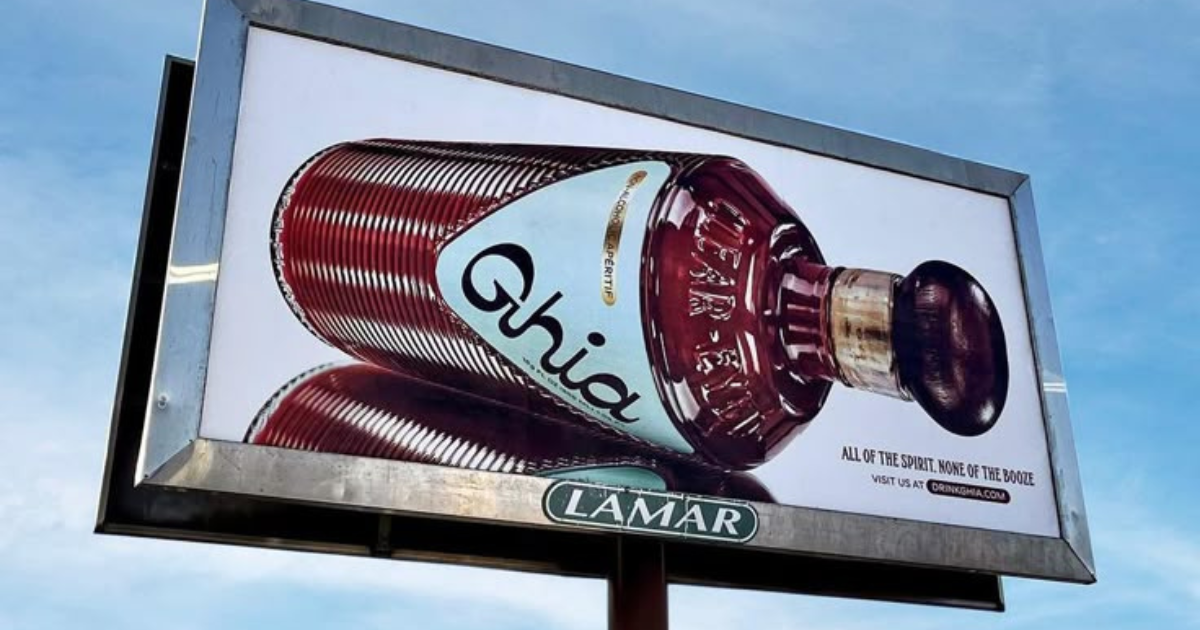
Look at Ghia, for instance. The brand didn’t scale purely through Instagram ads. In fact, they turned them off altogether, ultimately favoring upper funnel tactics like earned media and physical-world visibility. Pop-ups, experiential activations, and strategic OOH placements all reinforced cultural relevance. It focused on being seen in ways that made the brand feel inevitable.
The lesson here is that upper-funnel visibility can do strategic work that performance channels cannot, especially in a category still earning trust.
Times Square without the price tag
The traditional barrier to OOH has always been access. Historically, premium placements required agency relationships and six-figure commitments, both out of reach for most early-stage brands.
That’s what makes Rho’s Times Square program unusual. For qualifying businesses, the fintech company will cover the cost and design of a billboard placement in one of the most visible advertising environments in the world.
For non-alc brands, the real value here is the downstream signal: a moment that can be documented, repurposed, and referenced across investor conversations, retailer outreach, and owned channels.
Times Square isn’t the only way to approach OOH, but this program is a rare one that removes the usual barriers. For founders thinking about how to signal scale before they’ve fully achieved it, it’s a lever worth understanding.