In conversation with Wild AF co-founder Ryan Perry
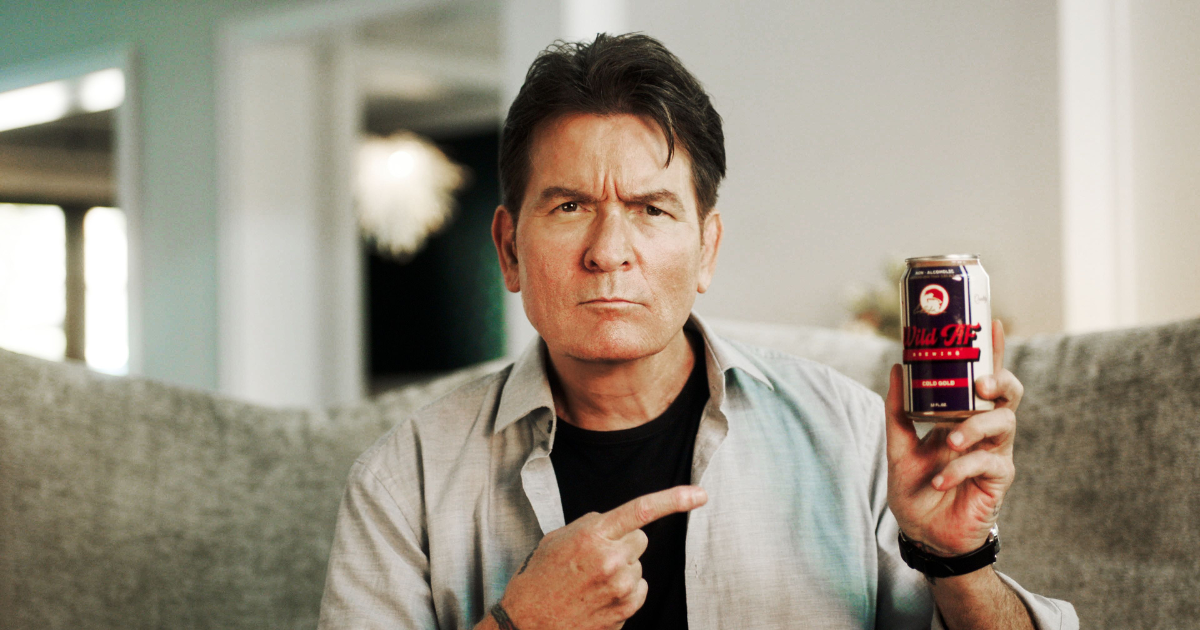
Charlie Sheen has re-entered the cultural conversation, and he’s done so deliberately. Over the past few months, his public reappearance has followed a tight sequence: a memoir, a documentary, and the launch of a non-alcoholic beer brand, Wild AF.
Behind the brand are co-founders Sheen, Ryan Perry, and Todd Christopher, with brewing by Harpoon Brewery. Its flagship beer, Cold Gold, is positioned as a familiar, no-frills American lager. It’s designed to feel like a ballpark beer, without the wellness signaling or functional claims that dominate much of the non-alc category.
In this interview with Dry Atlas co-founder Victoria Watters, Sheen and Perry explain why non-alc beer felt like the right space to enter at this moment, personally and culturally. They discuss Wild AF’s intentionally irreverent tone, why they believe the category has over-indexed on health framing, and how removing explanation and apology may be what finally helps non-alc beer feel mainstream.
Dry Atlas: You both could have built any consumer product together. From a business standpoint, why non-alcoholic beer?
Charlie Sheen: From the very first phone call, it just made perfect sense. I’d never really been a connoisseur of non-alcoholic beer, mostly because I hadn’t needed to be. I was still hanging onto a few bad experiences from the 1990s, when “near beer” was barely beer at all.
I quickly learned how far the technology has advanced. This is actual beer now. And after eight years without alcohol, I can’t tell you how many people have said to me, “Man, you’re the one person I always wanted to drink a beer with.” I thought, okay, let’s figure out a way where that can still happen.
It was a crash course for me. But all three of us, myself, Ryan, and our third co-founder, Todd Christopher, shared the same taste preferences and the same instinct for how we wanted people to feel when they drank our beer.
Ryan Perry: I grew up in the spirits business, learned a lot there, and worked with celebrity partners before. When Charlie and I met about three years ago, it was clear that this opportunity was true to both of our lives.
Charlie hadn’t consumed alcohol in years, and I had stepped away from drinking about a year and a half earlier. The non-alcoholic space, especially with a direct-to-consumer lens, felt like a sincere extension of who we were. From a business perspective, it was also exciting to help build brands in a category that still feels relatively new and open.
DA: Why launch Wild AF now?
CS: Three major projects showed up at the exact same time: my documentary, my memoir, and this beer. I saw it as a kind of hat trick. Three completely new challenges converging at once.
For a couple of years, my life became “book, doc, beer.” I was working under insane deadlines, just repeating that mantra in my home office. And almost unbelievably, all three projects were completed within the same month.
That’s kind of how things have always worked for me. Stuff falls out of the sky, and if it feels right, you take the shot. The only way to find out is to go straight through the heart of it.
DA: You’ve described this period as a reset rather than a comeback. Does that mindset extend to Wild AF as a business?
CS: Absolutely. The reset was about owning the story. Not from a place of vanity, but from a place of clarity. I wanted to set the record straight and show that there’s more to me than the caricature people remember.
Wild AF felt like the next chapter. It’s something I can really build. And importantly, it’s not reliant on film or television, or anyone else’s approval.
I’m deeply involved in everything: recipe development, design meetings, tastings. There are real stakes here, and that’s what makes it exciting.
DA: Ryan, who were you building this brand for from the start?
RP: We felt there was white space around not taking things so seriously. A lot of the category leans heavily into wellness or “better-for-you” messaging. That’s valid, but it’s not the whole picture.
We wanted to build something that could be fun, witty, and a little irreverent, while still being a serious, high-quality product. Those two things don’t have to be at odds.
We’re thinking about the sports fan, the social drinker, the person who enjoys the occasion… but not necessarily someone training for a marathon. More of an everyperson’s beer. Bringing fun back into the category without sacrificing credibility was always the goal.
DA: Charlie, how do you think about driving long-term awareness beyond your own name recognition?
CS: By staying true to that tone Ryan just described. And honestly, by riding a wave that’s already forming.
People, especially younger people, have more access to data and information than ever. There’s a growing desire to feel better, be more present, and stay connected. This isn’t about a resurgence in abstinence, but more generally about quality of life.
DA: Ryan, how does it change things when someone with Charlie’s visibility is a co-founder rather than a spokesperson?
RP: It changes everything. Charlie was never going to be spoon-fed talking points or asked to parrot a brand deck. He’s going to say what’s true to him.
That meant the only way to do this was to build something he genuinely believed in. We spent three years on the recipe because it had to be right. Anything less would have been obvious, and frankly, broken.
This isn’t about financial upside alone. We’re telling a true story. If it wasn’t real, people would see right through it.
DA: Zooming out, what do consumers still get wrong about non-alcoholic beer, and how is Wild AF responding to that?
RP: There’s still a sense that people need to justify why they’re not drinking in social situations. We wanted to remove that entirely.
Wild AF is a beer brand first. It just happens to be non-alcoholic. There’s no explanation required. You bring it to the party, that’s it. The category doesn’t need an asterisk.
CS: Exactly. People don’t want to feel left out, but they also don’t want to stand out for making a different choice. That tension still exists.
We’re making this cool. No more apologies or explanations. Something you’re proud to have in your hand.
This interview has been edited for length and clarity.